
Technical Exchange
Product Applications
- Compact Control Platform + Mobile Client in Small Production Systems
- How to understand cloud computing? Think of it like a food lover craving pizza...
- Do You Really Know What Cloud Computing Is?
- Walking in the Cloud: Who Pays for Your Security?
- Development and Applications of Cloud Computing
- A Brief Introduction to Cloud Computing and Virtualization
- The Future Data Center: Both Consolidated and Distributed
- Inside a Large-Scale Data Center
- Pros and Cons of Three Linux Server Monitoring Technologies
- 15 Mobile Terminal Trends for 2015
Cloud Computing
Data Center
Other


How to understand cloud computing? Think of it like a food lover craving pizza...
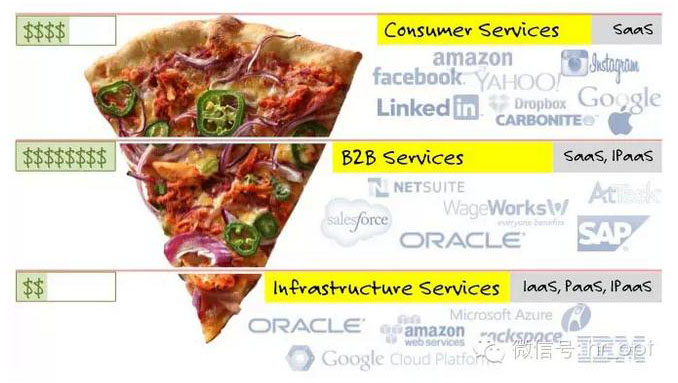
You have certainly heard of three lofty concepts in Cloud Computing: IaaS, PaaS and SaaS. These terms are not easy to understand. However, if you are a foodie who loves pizza, the problem is easy to solve. Well, you may not actually be a foodie at all. The reason you call yourself one is really just to fish for compliments like "You eat so much and still stay so thin, I'm so jealous!" Or perhaps you just need a decent excuse for being a little plump.
How does a "foodie" get pizza?
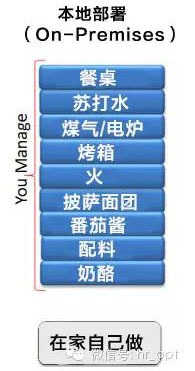
1. Make it at home。
This is quite a hassle. You need to prepare many things: make the dough, let it rise, put it in the oven... To put it simply, you need everything shown in the image below:
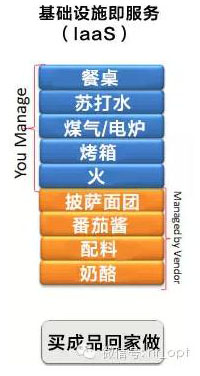
2. Buy ready-made pizza and bake it at home。
You just need to buy the finished product from a pizza shop, bake it at home and eat it at your own table. Unlike making it from scratch at home, you need a pizza supplier.
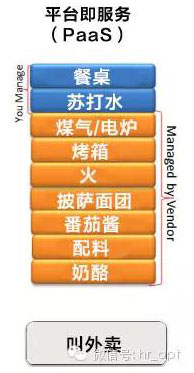
3. Call for delivery and have pizza brought to your door。
Make a phone call and pizza is delivered to your doorstep.
4. Eat pizza at a pizza shop。
You do not need to prepare anything; even the table belongs to the pizza shop.
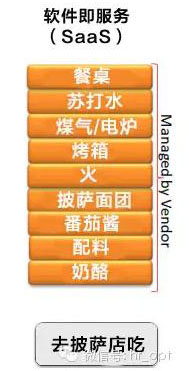
To summarize, a foodie can get pizza through the following methods:
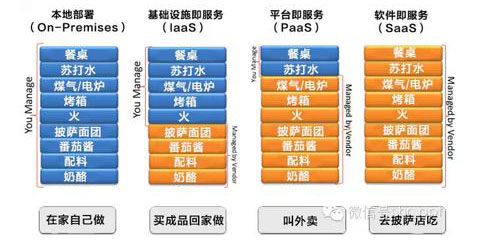
Now, forget about pizza!
Suppose you are a top-tier tech company that needs no outside services. You own the infrastructure, applications and everything else. You divide them into three layers: infrastructure, platform and software, as shown below:
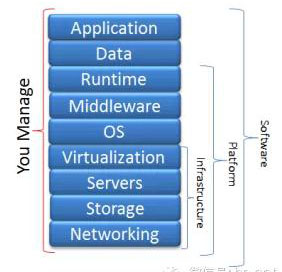
These are actually the three layers of Cloud Computing. Infrastructure is at the bottom, platform is in the middle and software is on top, corresponding to Infrastructure-as-a-Service (IaaS), Platform-as-a-Service (PaaS) and Software-as-a-Service (SaaS). Other "soft" layers can be added on top of these.
Your company has everything, and its current state is called on-premises deployment, just like making pizza at home. A few years ago, if you wanted to run enterprise applications in your office or on your company's website, you needed to buy servers or other expensive hardware to run local applications and keep your business going. That is what on-premises deployment means.
Suppose one day your boss has an epiphany: why make pizza yourself just to eat it? So you start considering a cloud service provider. What services can this provider offer? The cloud services available are the three layers of Cloud Computing: IaaS, PaaS and SaaS, just like a pizza shop offering three types of service: buy and bake at home, delivery and dine-in.
Illustrated in one diagram, it looks like this:
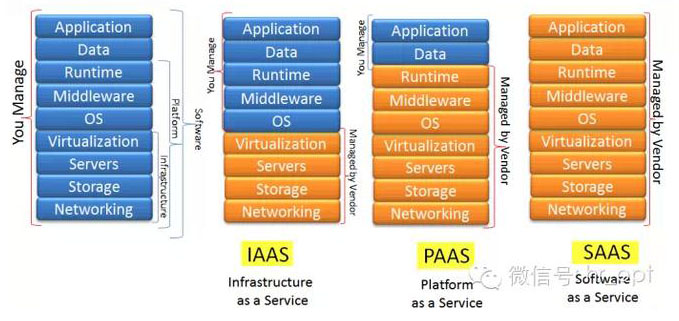
Now let's talk about the specifics.
IaaS: Infrastructure-as-a-Service
With IaaS, you can outsource your hardware. IaaS providers offer off-site servers, storage and networking hardware that you can rent. This saves maintenance costs and office space, allowing your company to run its applications on this hardware at any time.
Some major IaaS companies include Amazon, Microsoft, VMWare, Rackspace and Red Hat. Each has its own specialty. For example, Amazon and Microsoft offer more than just IaaS; they also rent out their computing power to host your website.
PaaS: Platform-as-a-Service
The second layer is PaaS, sometimes also called middleware. All of your company's development can take place on this layer, saving time and resources.
PaaS providers offer various online solutions for developing and distributing applications, such as virtual servers and operating systems. This saves you hardware costs and makes collaboration between distributed teams easier. Services include web application management, application design, application virtual hosting, storage, security and application development collaboration tools.
Some major PaaS providers include Google App Engine, Microsoft Azure, Force.com, Heroku and Engine Yard. More recent entrants include AppFog, Mendix and Standing Cloud.
SaaS: Software-as-a-Service
The third layer is SaaS. This is the layer you interact with every day, mostly accessed through a web browser. Any application running on a remote server that can be used over the network is SaaS.
The services you consume are accessed entirely through the web, from Netflix, MOG, Google Apps, Box.net, Dropbox to Apple's iCloud, all falling into these categories. Although these web services are used for business, entertainment or both, they are also part of cloud technology.
Some SaaS applications used for business include Citrix's Go To Meeting, Cisco's WebEx, Salesforce's CRM, ADP, Workday and SuccessFactors.
Source: 51CTO.com